The Helicopter Company Orders Eight Additional Airbus H145 Helicopters
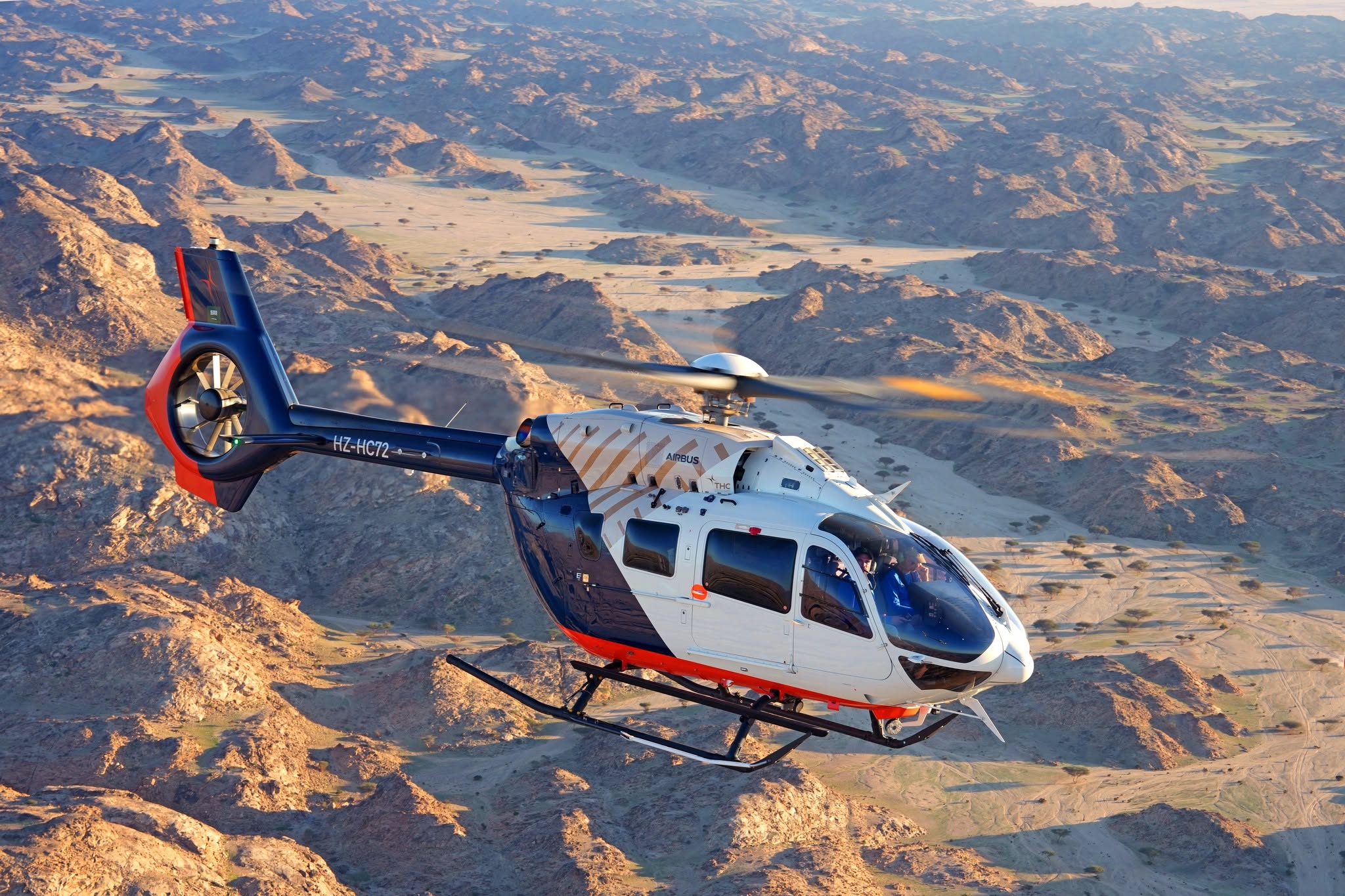
The Helicopter Company, a Saudi Arabian rotorcraft operator owned by the country’s Public Investment Fund, has placed a firm order for eight additional Airbus H145 helicopters, the companies announced on 20 July 2026 at the Farnborough International Airshow.
The aircraft are scheduled for delivery between 2027 and 2028. The order falls under a framework agreement the two companies signed at the Verticon helicopter industry conference in 2024, covering up to 120 Airbus helicopters of various types over a three- to five-year period, according to Airbus Helicopters.
Airbus and THC described the order as part of a structured approach to fleet growth. By spreading the new deliveries across a two-year window, the companies said, THC intends to integrate the aircraft into its operations without disruption. The H145s are expected to support the operator’s emergency medical services and other operations across Saudi Arabia and beyond, according to the companies.
“The additional order of H145s reinforces the dynamic partnership we have developed with Airbus over the past six years. By investing in a fleet that is optimised, agile and future-ready, THC is strengthening our ability to anticipate and meet our customers’ evolving needs while supporting the Company’s next phase of development. The eight additional H145s will help to enhance our operational capabilities and position THC to further extend our footprint beyond the Kingdom, reinforcing our standing as both a regional and local leader and an increasingly prominent global player in aviation.”
Captain Arnaud Martinez, CEO of THC
“We are honoured to further deepen our partnership with The Helicopter Company through this additional commitment for eight H145s. This agreement is a testament to the trust THC places in our multi-mission platforms to support the Kingdom’s rapidly expanding aviation ecosystem. The H145 has already proven its excellence in Saudi Arabia’s demanding ‘hot and high’ conditions, and we are proud and we are proud to see the growing number of H145s powering THC’s operations as they scale their world-class services.”
Matthieu Louvot, CEO of Airbus Helicopters
Speaking to reporters at a briefing during the airshow, Martinez said THC had not yet determined the specific roles the new aircraft would fill, saying the operator would decide as the helicopters are incorporated into the fleet in the coming years. The aircraft will be delivered in a multi-mission configuration, according to the company, which gives THC flexibility in how it deploys them once they arrive.
THC has introduced the H145 into service for emergency medical services in Saudi Arabia and has also deployed the aircraft in support of the Dakar Rally, according to the companies. The operator has grown across multiple segments in recent years, including aerial utility work, VIP transport, aerial tourism, emergency medical services and search-and-rescue operations.
The companies said the latest order supports Saudi Arabia’s Vision 2030 economic development program by strengthening the country’s aviation sector and expanding access to helicopter services domestically and internationally.
THC currently operates a fleet that includes 25 Airbus H125s, 11 Airbus H160s and 39 Airbus H145s, along with helicopters made by Italian manufacturer Leonardo, according to the company. THC operates from roughly 20 bases across Saudi Arabia. The earlier framework agreement between THC and Airbus included 10 firm orders for the H145, in addition to the broader option for up to 120 aircraft across Airbus’s helicopter range.
The H145 is a twin-engine, four-tonne-class helicopter and the newest member of Airbus Helicopters’ twin-engine rotorcraft lineup, according to Airbus. The manufacturer says the aircraft is designed for mission flexibility, with particular emphasis on performance in high-altitude and high-temperature, or “hot and high,” operating conditions — a characteristic relevant to much of Saudi Arabia’s terrain and climate.
The current H145 variant, introduced in 2020, uses a five-blade main rotor system that Airbus says increases useful load compared with the earlier four-blade version and gives the aircraft what the company describes as the best useful-load-to-maximum-takeoff-weight ratio in its class. The aircraft is powered by two Safran Arriel 2E turboshaft engines with dual-channel digital engine control. Airbus says the helicopter can carry up to 10 passengers in a high-density configuration, or fewer passengers alongside stretchers and medical crew in emergency medical configurations.
For Saudi Arabia, the order is another marker of the kingdom’s push to build out commercial aviation infrastructure as part of Vision 2030, the government’s long-term plan to diversify the economy away from oil revenue. THC, wholly owned by the Public Investment Fund, has expanded rapidly since its founding, and a larger H145 fleet is likely to translate into more emergency medical helicopters serving Saudi communities, along with expanded utility and tourism services — areas where the government has said it wants to build capacity largely absent in the kingdom a decade ago.
The practical effect for people living in or visiting Saudi Arabia is most direct in emergency medical services. THC has already put the H145 to work in that role, and an expanded fleet suggests capacity for faster response times or broader geographic coverage as new aircraft come online through 2028 — though the company has not specified how many of the eight new helicopters will go toward EMS work versus other missions such as offshore transport, VIP travel or search-and-rescue. Martinez’s comments at Farnborough suggest THC is deliberately keeping that flexibility, ordering aircraft in a multi-mission configuration it can adapt to whichever service line grows fastest rather than committing years in advance to a fixed mix.
The order also illustrates how large, multiyear framework agreements function in the aircraft industry: the 2024 Verticon agreement for up to 120 helicopters was not itself a firm commitment to buy that many aircraft, but rather an option THC and Airbus have been converting into firm orders in smaller batches — 10 H145s initially, and now eight more — as THC’s needs become clearer. That structure lets an operator scale its fleet in step with actual demand rather than taking delivery of a large number of aircraft at once, while giving Airbus a degree of long-term order visibility for planning production. Whether THC exercises more of the remaining options in the framework agreement, and for which aircraft types, will depend on how quickly its emergency medical, tourism and utility businesses continue to grow in the coming years.
The Helicopter Company orders 11 more Leonardo helicopters as fleet expansion continues
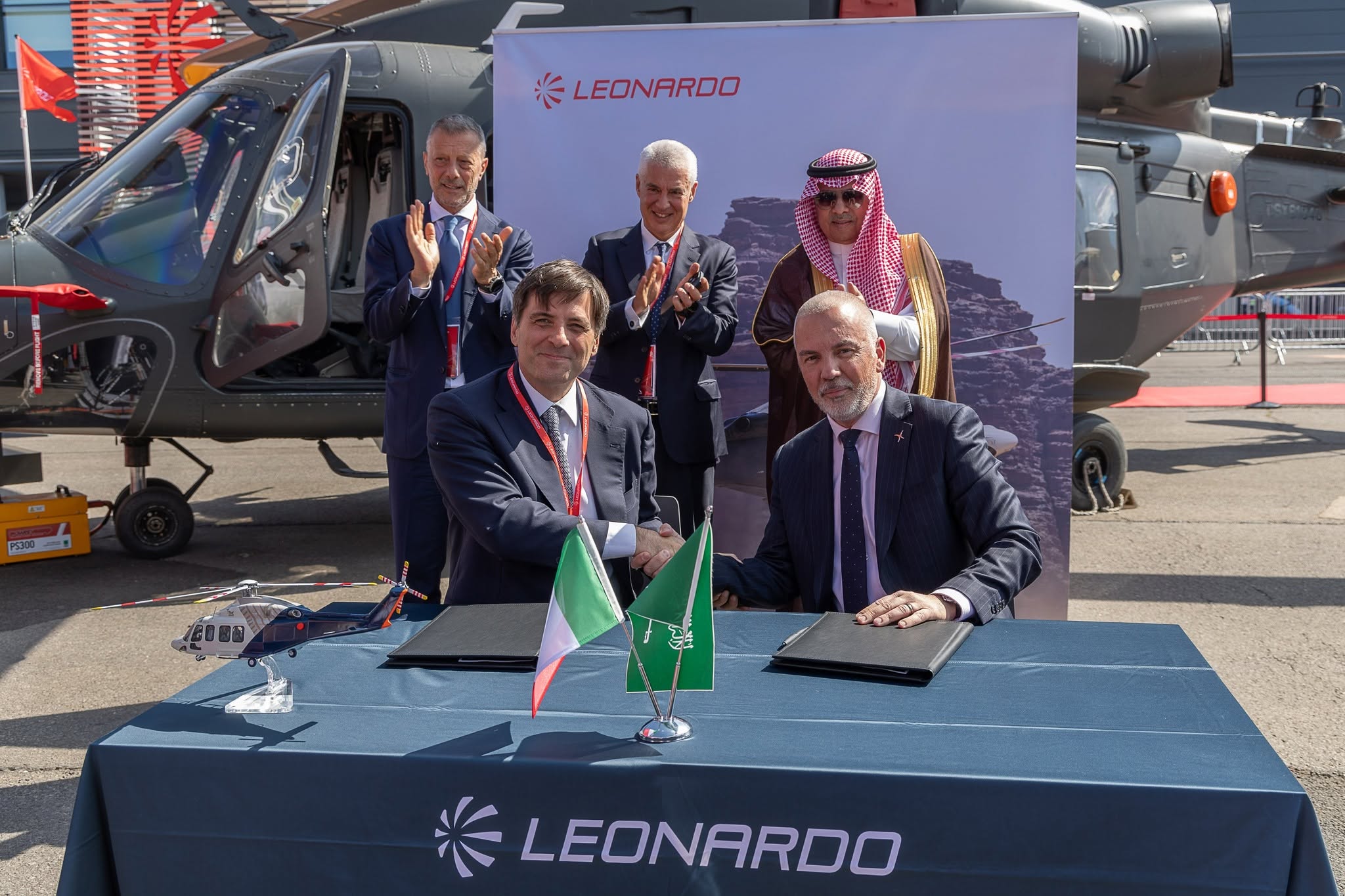
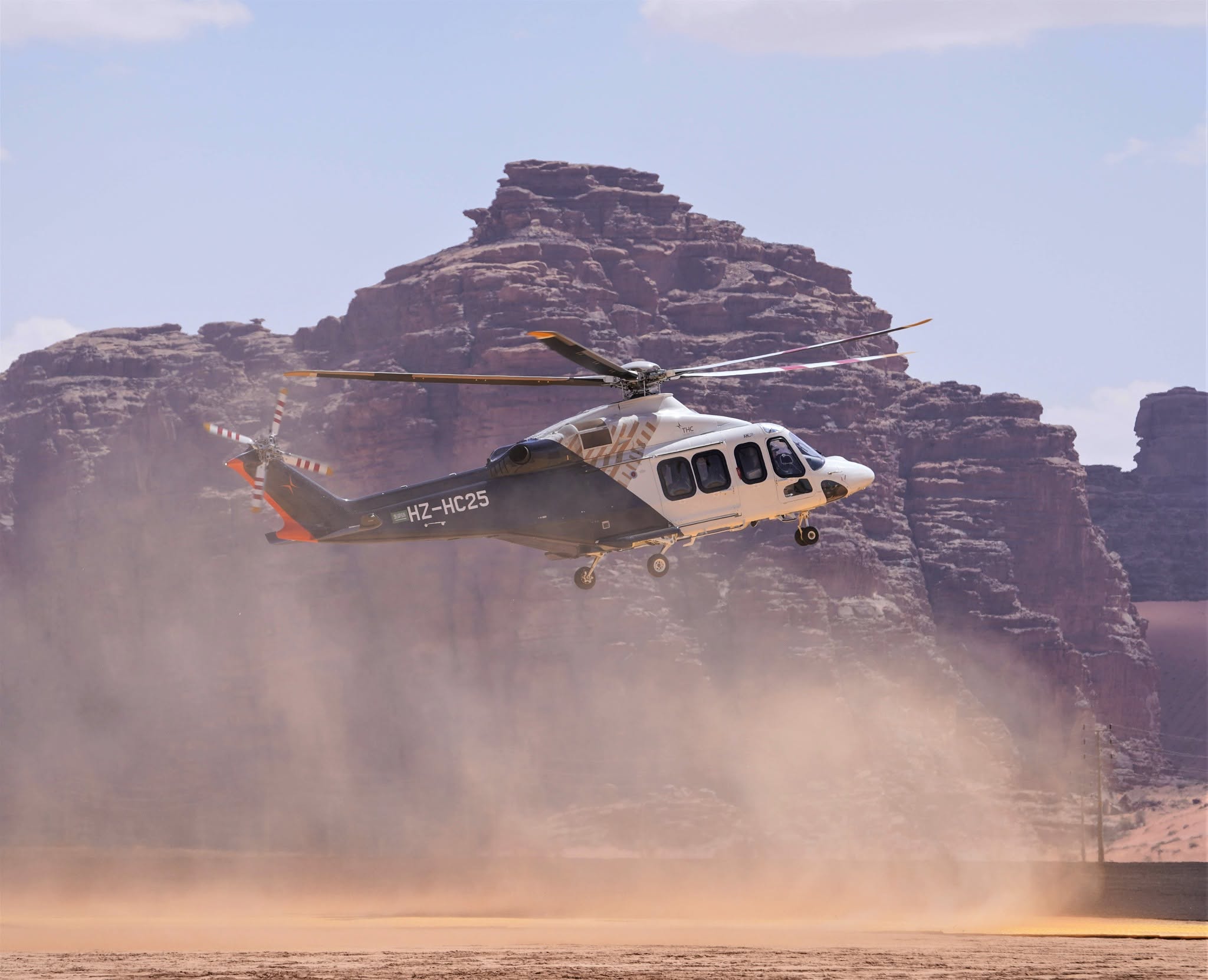
The Helicopter Company (THC), a Public Investment Fund company and Saudi Arabia’s largest commercial helicopter operator, has placed a firm order for 11 additional AW139 helicopters from Italian manufacturer Leonardo, the two companies announced Tuesday at the Farnborough International Airshow.
The intermediate twin-engine helicopters are scheduled for delivery between 2027 and 2028. The order falls under a framework agreement signed by THC and Leonardo at the HAI Heli-Expo event, now known as Verticon, in 2024, which allows for the potential acquisition of up to 130 aircraft over time.
Leonardo and THC described the deal as a step within that broader multi-year arrangement, which underpins THC’s plan to expand and adjust the composition of its helicopter fleet as it grows its operations both within Saudi Arabia and internationally.
The order adds to a fleet that already makes THC one of the largest AW139 operators in the world. The aircraft are used across a range of THC’s operations, including emergency medical services, VIP transport and offshore flights supporting the energy sector. Company officials said the new helicopters would add capacity across those services as demand grows.
Captain Arnaud Martinez, chief executive of THC, said in a statement: “We are proud to expand our long-standing partnership with Leonardo, which strengthens our leadership and operational capabilities in the region and beyond. Building on our existing AW139 fleet, which has made THC one of the largest and most recognised operators worldwide, this new order will contribute to our fleet optimization strategy while supporting our plans to grow our global footprint.”
Gian Piero Cutillo, co-general manager of Leonardo and managing director of Leonardo Helicopters, said the order marked further progress in a modernisation programme the two companies began two years ago. “We are very pleased to move forward into the next stage of THC’s Leonardo helicopter fleet expansion and modernisation plan, which we launched two years ago, having also recently celebrated the delivery of the operator’s 40th aircraft,” Cutillo said. “We stand ready and committed to supporting THC through its long-term strategy project to make sure our technology provides the high standard of service KSA’s communities expect.”
According to Leonardo, the AW139 is the best-selling helicopter in its class worldwide, with close to 1,600 units ordered by roughly 300 customers in more than 90 countries. The company said the type has been particularly popular in the Middle East, where about 18% of the global AW139 fleet is currently based.
Leonardo and THC said the latest order supports the goals of Saudi Vision 2030, the kingdom’s economic diversification programme, which includes plans to build out its aviation sector. Representatives of both companies held discussions on their broader strategic plans during the Farnborough show, which runs through 24 July 2026.
The announcement is one of several helicopter and aircraft deals unveiled by Leonardo during the airshow, as manufacturers use the biennial event to showcase orders from commercial and defence customers.
The order underscores the extent to which Gulf carriers, and Saudi Arabia in particular, have become central to the world’s rotorcraft market. THC’s fleet already accounts for a meaningful share of the roughly 1,600 AW139s in service or on order globally, and the region as a whole now hosts close to a fifth of the type’s worldwide fleet. That concentration reflects the scale of investment Gulf states are pouring into aviation infrastructure, offshore energy support and emergency medical networks as part of broader economic diversification plans, of which Saudi Vision 2030 is the most prominent example.
For Leonardo, the deal reinforces the AW139’s position as the manufacturer’s commercial workhorse and provides a degree of order visibility stretching toward the end of the decade, at a time when helicopter manufacturers are competing for a limited pool of large fleet operators capable of absorbing double-digit aircraft orders in a single transaction. The framework agreement’s ceiling of up to 130 aircraft, of which this order forms a part, also gives Leonardo a substantial pipeline of potential future business, subject to THC converting further options into firm orders.
More broadly, the transaction illustrates how state-backed investment vehicles, in this case the Public Investment Fund, are increasingly shaping demand in the civil helicopter sector, using large domestic operators to build national aviation capability while diversifying beyond oil revenues. For airlines, medical operators and offshore energy firms elsewhere, THC’s growth as an AW139 operator may also influence used-aircraft values, parts and maintenance networks, and pilot training pipelines for the type, given the scale it is reaching. Whether the remaining aircraft under the framework agreement are eventually ordered will likely depend on how quickly THC’s various service lines, particularly EMS and offshore transport, continue to expand within the kingdom and in nearby markets.
Bell Delivers 700th Bell 505 Helicopter at Farnborough Airshow
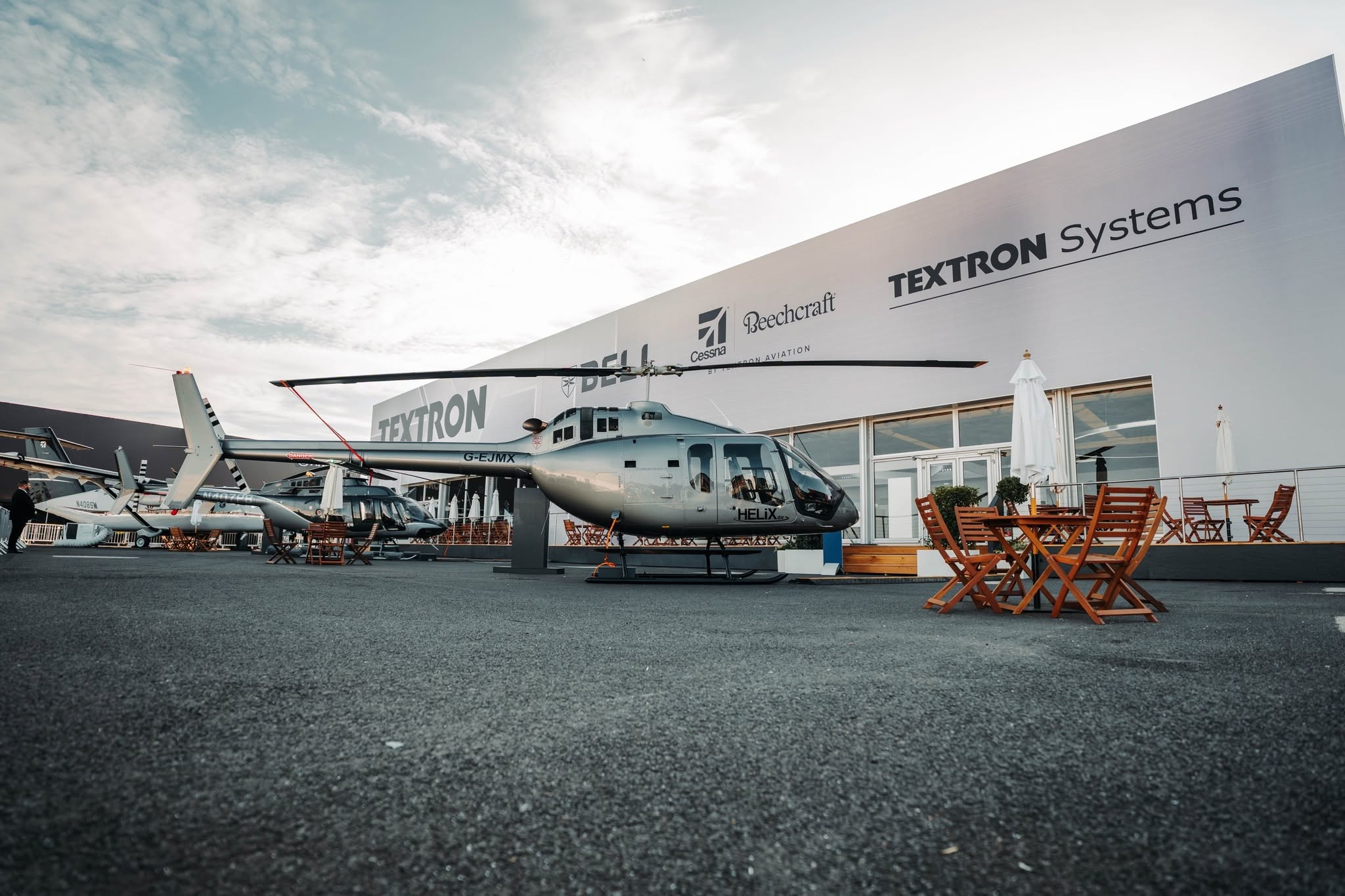
Bell Textron Inc. announced on 20 July 2026 that it has delivered the 700th Bell 505 helicopter, handing the aircraft to a private VIP operator during the Farnborough International Airshow. Bell, a subsidiary of Textron Inc. (NYSE: TXT), said the milestone delivery reflects the aircraft’s popularity in the corporate helicopter segment since it entered service in 2017.
“Our team is honored to ring in this Bell 505 milestone right here at the Farnborough International Airshow. The Bell 505 is an incredible multi-mission aircraft, and we continue to see operators choosing this platform to join their fleet. We look forward to welcoming our newest operator to the Bell family, while also celebrating all of our Bell 505 operators across the different mission segments throughout the world.”
Robin Wendling, managing director, Europe, Bell
The Bell 505, known formally as the Jet Ranger X, is a light, single-engine helicopter that Bell developed as a successor to the long-running Bell 206 JetRanger, production of which ended in 2010. The 505 completed its first flight in November 2014 at Bell’s manufacturing site in Mirabel, Quebec, and entered service in 2017. Final assembly of the aircraft takes place in Canada.
Since its introduction, the Bell 505 has accumulated more than 390,000 flight hours and operates in more than 55 countries across six continents, according to Bell. The aircraft is built around the rotor and drive system used in the Bell 206L-4, a design lineage the company says gives the 505 handling characteristics familiar to pilots of its predecessor, combined with updated avionics.
The helicopter is powered by a single Safran Helicopter Engines Arrius 2R turboshaft, controlled by a dual-channel Full Authority Digital Engine Control system that Bell says is the only one of its kind in its class. The aircraft has a maximum cruise speed of around 125 knots (232 km/h) and seats up to four passengers alongside a pilot. Its flight deck uses a Garmin G1000H NXi avionics suite with dual 10.4-inch displays. List pricing for the aircraft has been reported at around $1.86 million.
The Bell 505 competes in the light single-engine helicopter segment against aircraft such as the Robinson R66 and Airbus’s H120 and H125 models, and is used across roles including private and VIP transport, pilot training, utility work, tourism and law enforcement.
Beyond the VIP travel segment, Bell said the Bell 505 serves as a training platform for militaries in Jordan, Bahrain, the United Arab Emirates, Albania, Montenegro, Indonesia, Iraq and South Korea, preparing pilots for later transition to more advanced aircraft.
The company said the helicopter’s open cabin design, which includes stadium-style seating for passengers and trainees in the rear, allows students to observe flight operations from every seat, an arrangement Bell has described as giving the aircraft the feel of a flying classroom. Bell said the surrounding glass cockpit also provides wide operational visibility for instructors and trainees alike.
Bell’s announcement came during the Farnborough Airshow, at which the company also showcased its MV-75 Cheyenne tiltrotor aircraft, which is being developed for the US Army’s Future Long-Range Assault Aircraft programme. The 700th delivery announcement was made separately, alongside Bell’s other news from the show.
Reaching 700 deliveries is a notable production milestone for a helicopter that has been in service for less than a decade, and it signals that Bell has established the 505 as a durable presence in a competitive light single-engine market rather than a niche product. For prospective buyers — corporate flight departments, private individuals, flight schools and government training programmes — a large and growing operator base of this kind tends to matter in practical ways beyond the aircraft itself: it generally means a deeper pool of spare parts, more maintenance facilities familiar with the type, stronger resale values, and a larger community of pilots and mechanics with hands-on experience on the platform. Those factors are often as important to a buyer’s decision as an aircraft’s specifications on paper.
The delivery to a private VIP operator also underlines a broader pattern in the light helicopter market, where demand for compact, relatively affordable aircraft for executive and personal transport has continued alongside more specialised uses such as law enforcement and search and rescue. At a list price in the region of $1.86 million, the Bell 505 sits toward the lower end of the turbine helicopter market, which has helped it draw both first-time helicopter owners and operators upgrading from older piston or turbine aircraft.
The aircraft’s expanding role in military pilot training, now spanning eight countries from the Gulf to South East Asia, is arguably the more consequential development for governments and defence planners. Turbine trainer aircraft such as the 505 are typically less expensive to acquire and operate than the larger, more complex helicopters air forces ultimately fly operationally, allowing armed forces to build up basic rotary-wing flying skills before pilots transition to combat or utility types. A widening customer base of this kind, across a geographically diverse set of militaries, can also help Bell sustain production volumes and, in turn, keep unit and support costs more predictable for all operators of the type, both military and civilian.
Photos by the respective brands.


