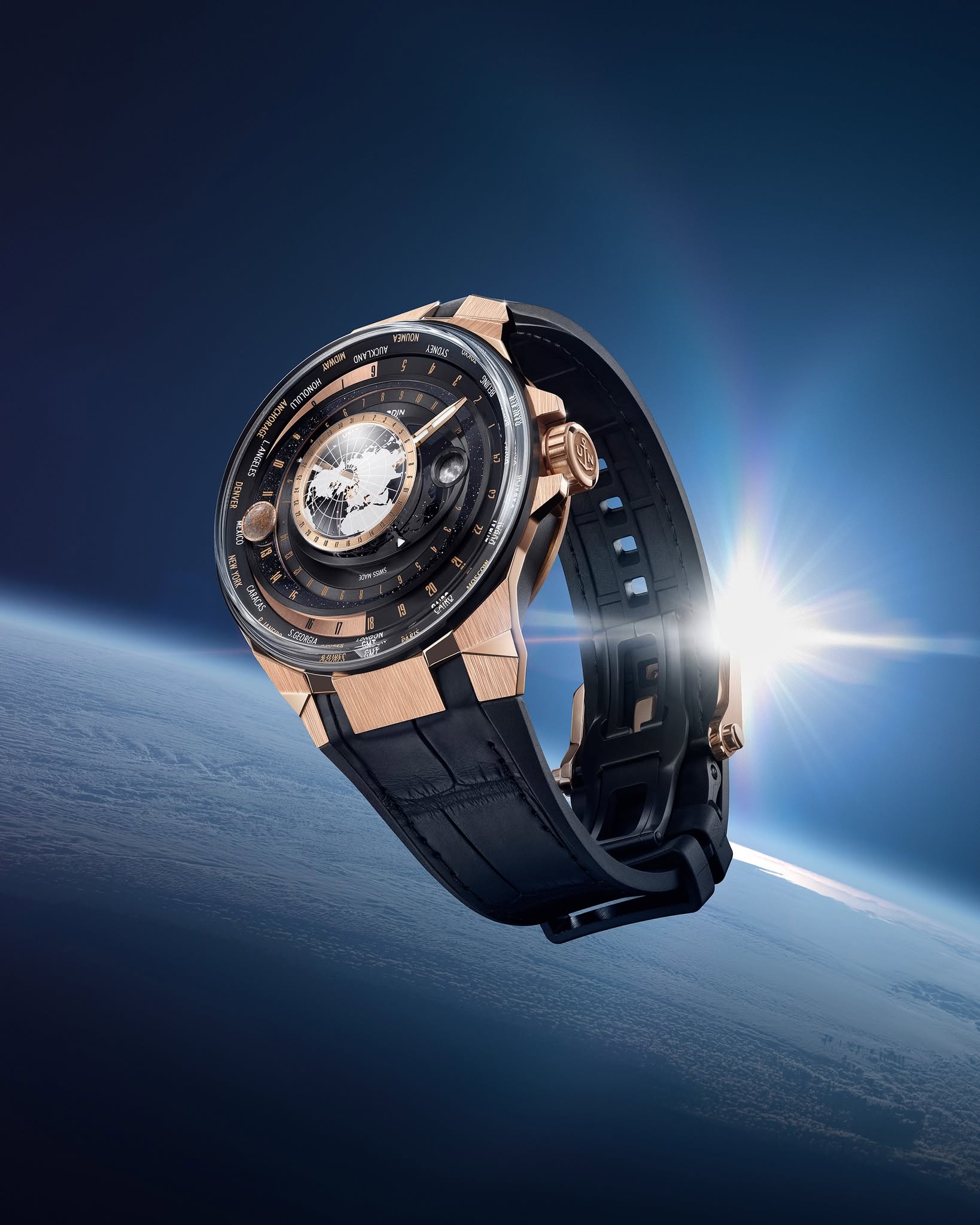
Swiss watchmaker Ulysse Nardin has introduced the Blast Moonstruck in rose gold (reference number 1065-400LE-2A-BLACK/1A), a limited-edition watch that traces its design back to the company’s decades-long history of building astronomical timepieces, the manufacturer announced. It is part of the Blast collection and represents what Ulysse Nardin describes as one of its more complex astronomical watches currently in production.
Ulysse Nardin, founded in 1846 in Le Locle, Switzerland, built its early reputation on marine chronometers used by navies and scientists for navigation, geodesy and earth sciences. The brand has received more than 4,300 technical and design awards over its history and has introduced several developments in Swiss watchmaking, including early use of silicon components and a perpetual calendar that could be set both forward and backward through the crown.
The Blast Moonstruck in rose gold is the latest addition to Ulysse Nardin’s Blast collection, which the company has positioned as a showcase for its more technically involved watchmaking. The Moonstruck line itself dates to 2009, when Ulysse Nardin released the first Moonstruck watch, also developed by Oechslin, combining the earth, sun and moon into a single display rather than the multiple separate mechanisms used in the company’s earlier astronomical watches from the 1980s.
Astronomical functions have been part of Ulysse Nardin’s watchmaking output since the 19th century, when the company produced moon phase watches and calendar timepieces intended for scientific observation and maritime navigation. The company said a new phase of that work began in 1983, shortly after entrepreneur Rolf Schnyder acquired the manufacture and redirected it toward more experimental watchmaking.
That same year, Schnyder met Dr. Ludwig Oechslin, a watchmaker, astronomer and mathematician who would go on to shape much of Ulysse Nardin’s astronomical watchmaking output over the following decades. According to the company, Schnyder came across an astronomical clock built by Oechslin while visiting master watchmaker Jörg Spöring in Lucerne. Struck by the mechanism, Schnyder asked Oechslin whether a similar instrument could be built into a wristwatch.
The resulting project took two years. In 1985, Oechslin completed the Astrolabium Galileo Galilei, a wristwatch later credited by Guinness World Records as the first astronomical wristwatch. Ulysse Nardin said the piece pushed the limits of what could be built into a watch case at the time.
Ulysse Nardin now continues that line of work with the Blast Moonstruck in rose gold, which the company describes as one of its most sophisticated astronomical complications to date.
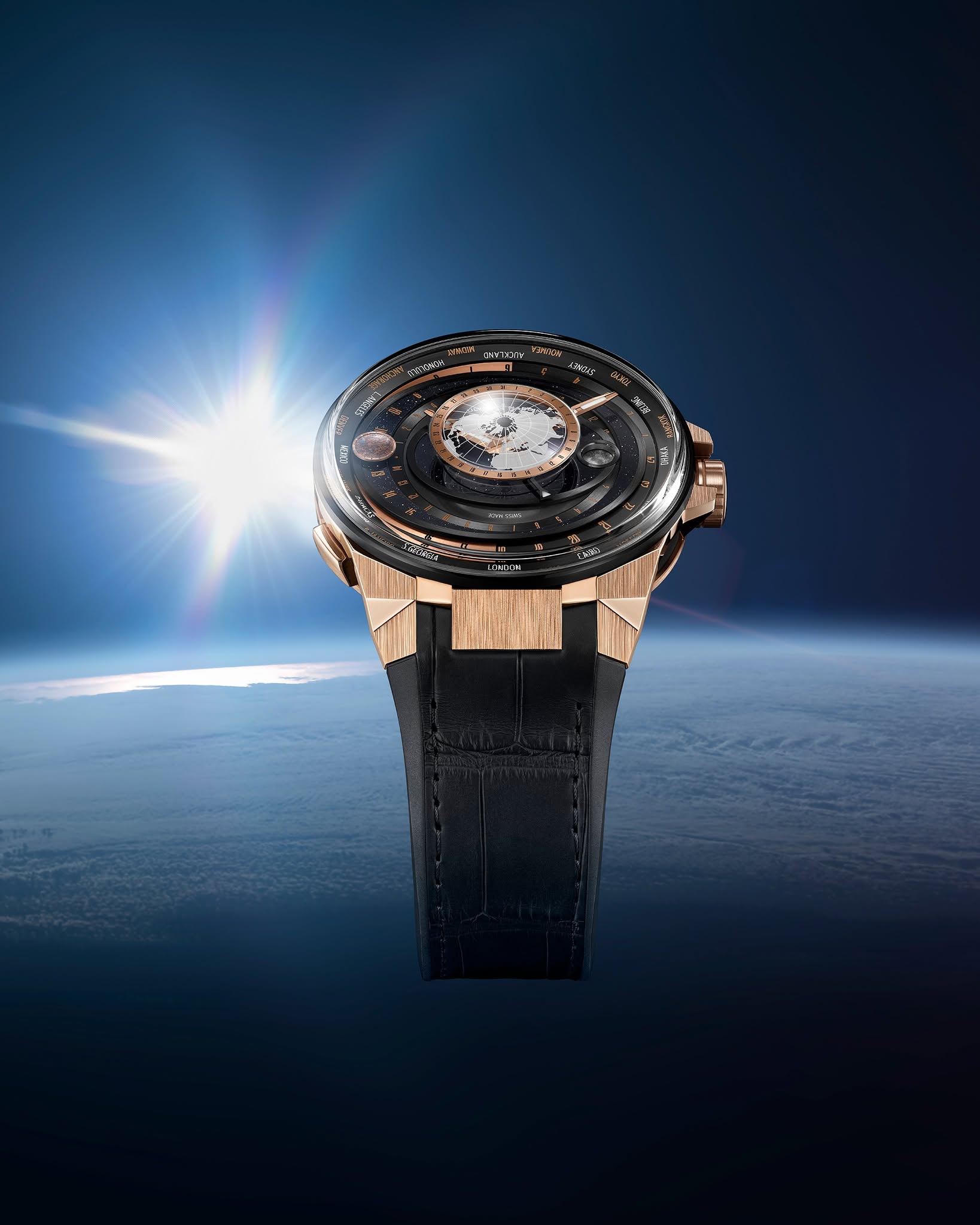
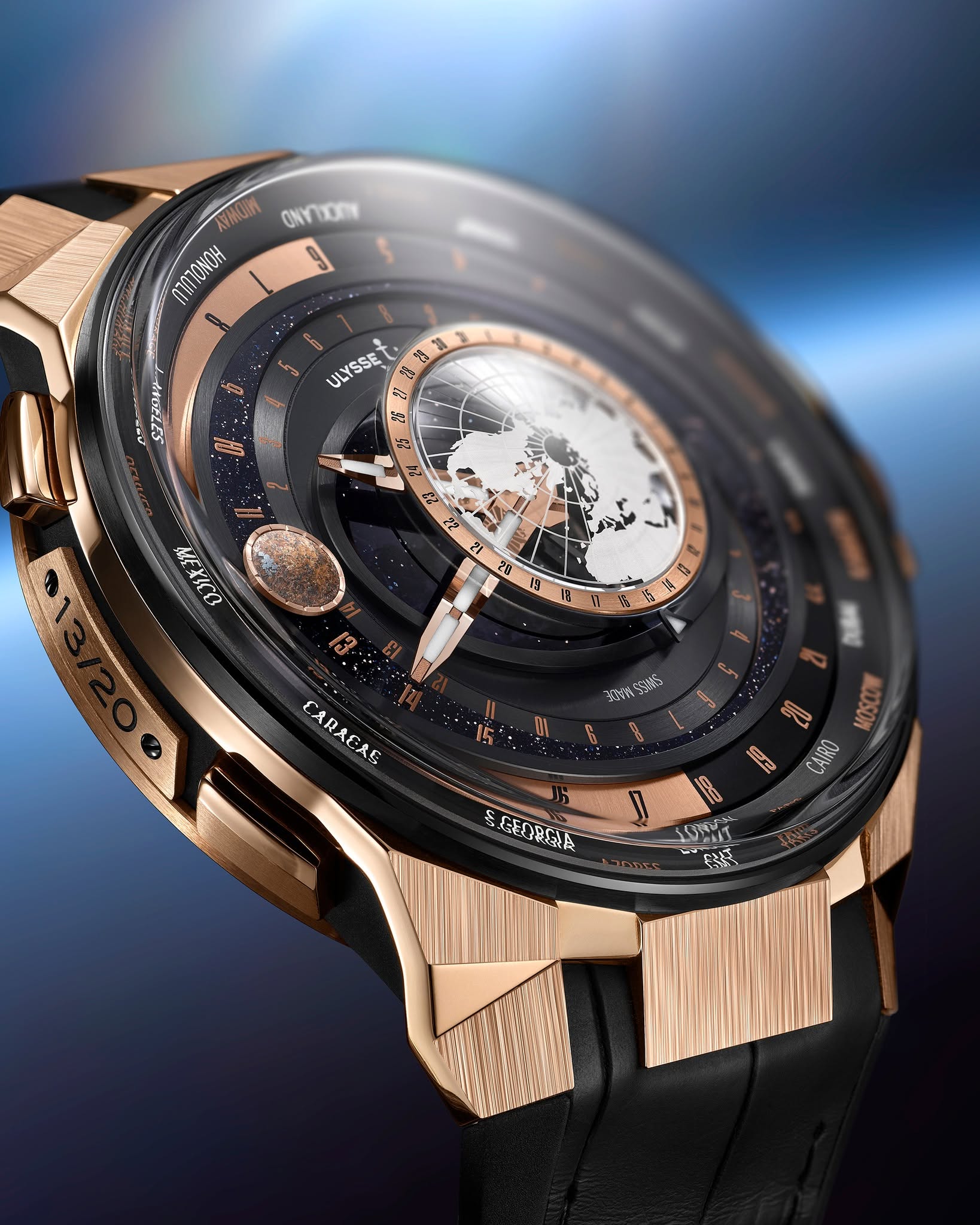
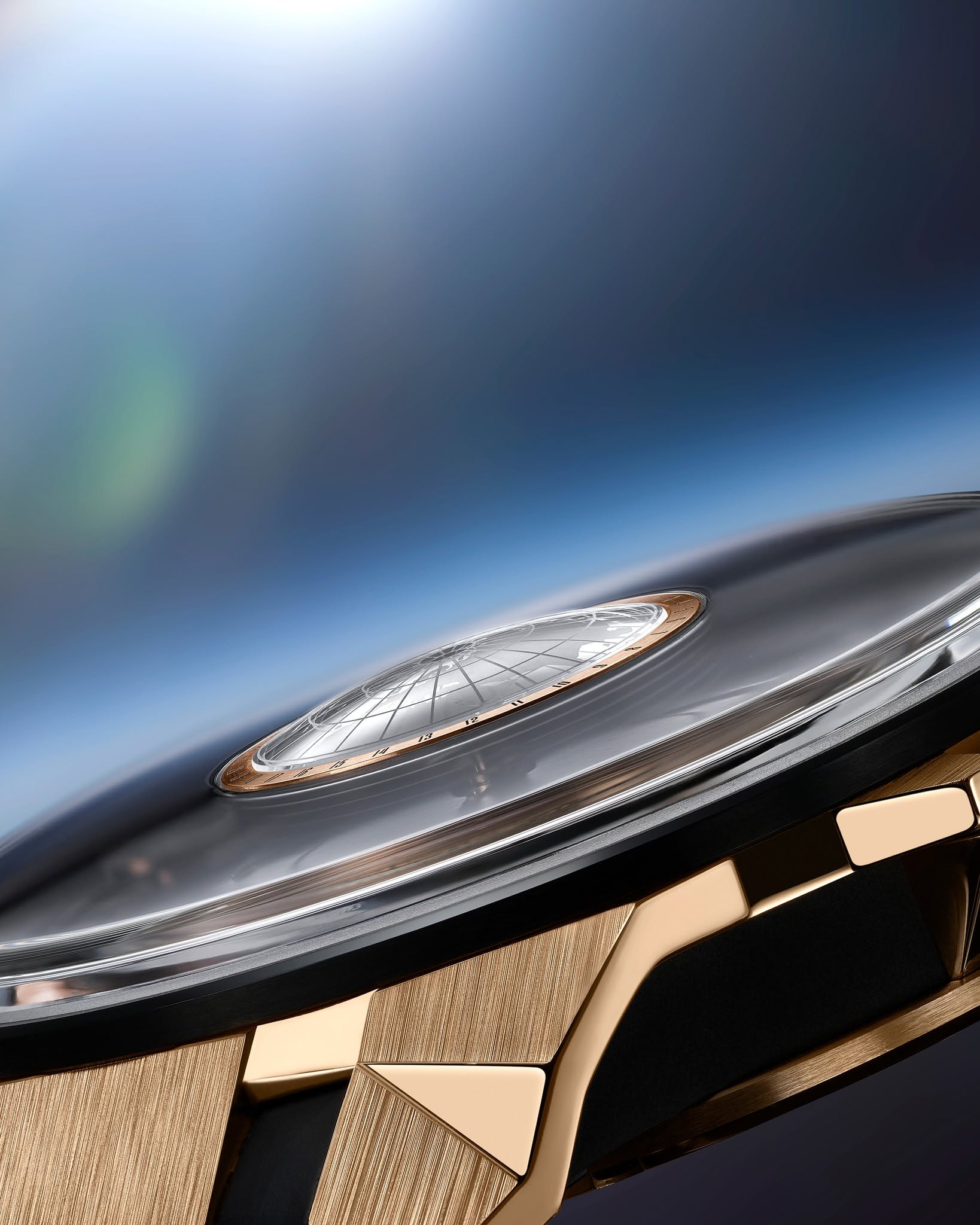
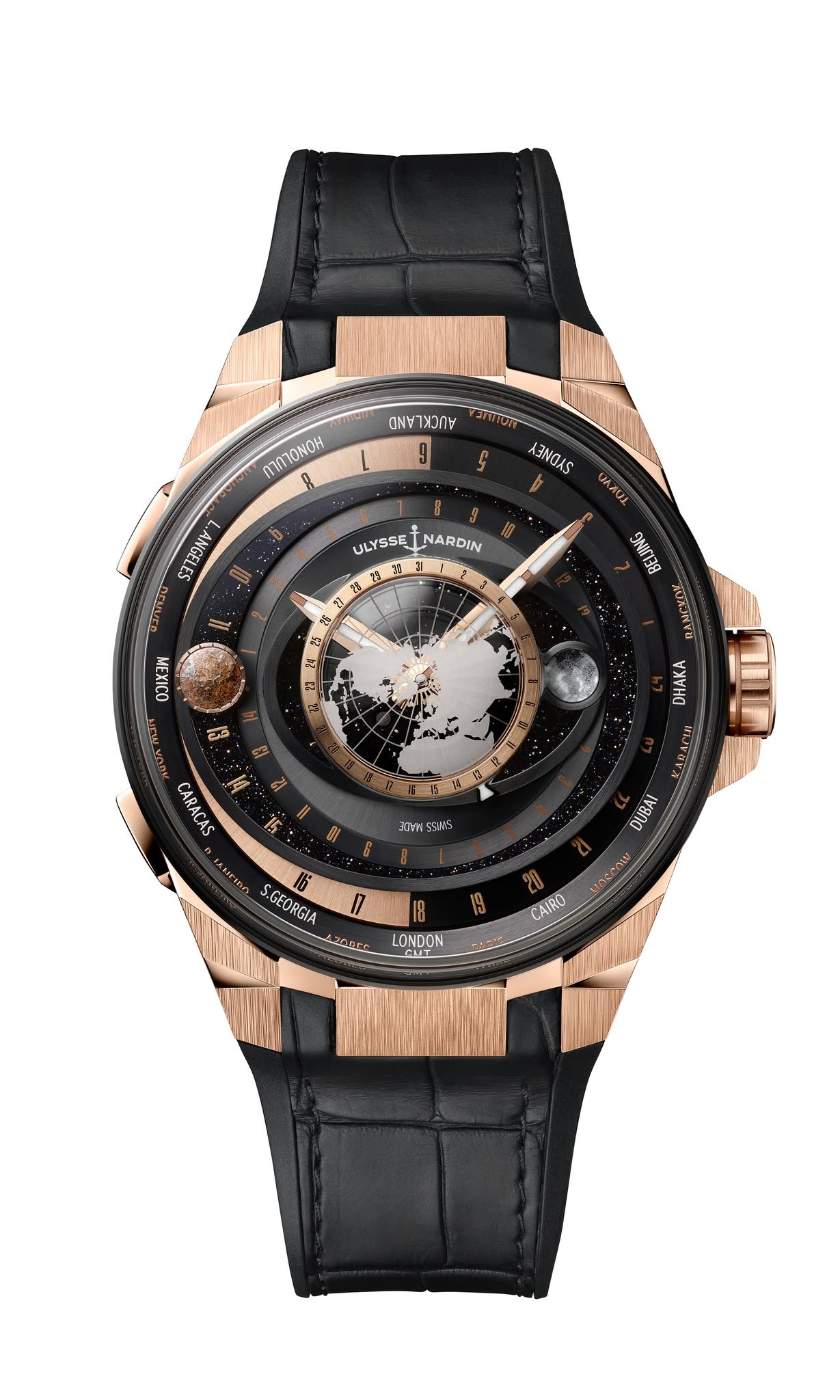
The Blast Moonstruck is built around a geocentric display, meaning the watch places the Earth at the center of its dial and shows the movement of the sun and moon as they would appear from the Earth’s surface, rather than charting their actual orbital paths.
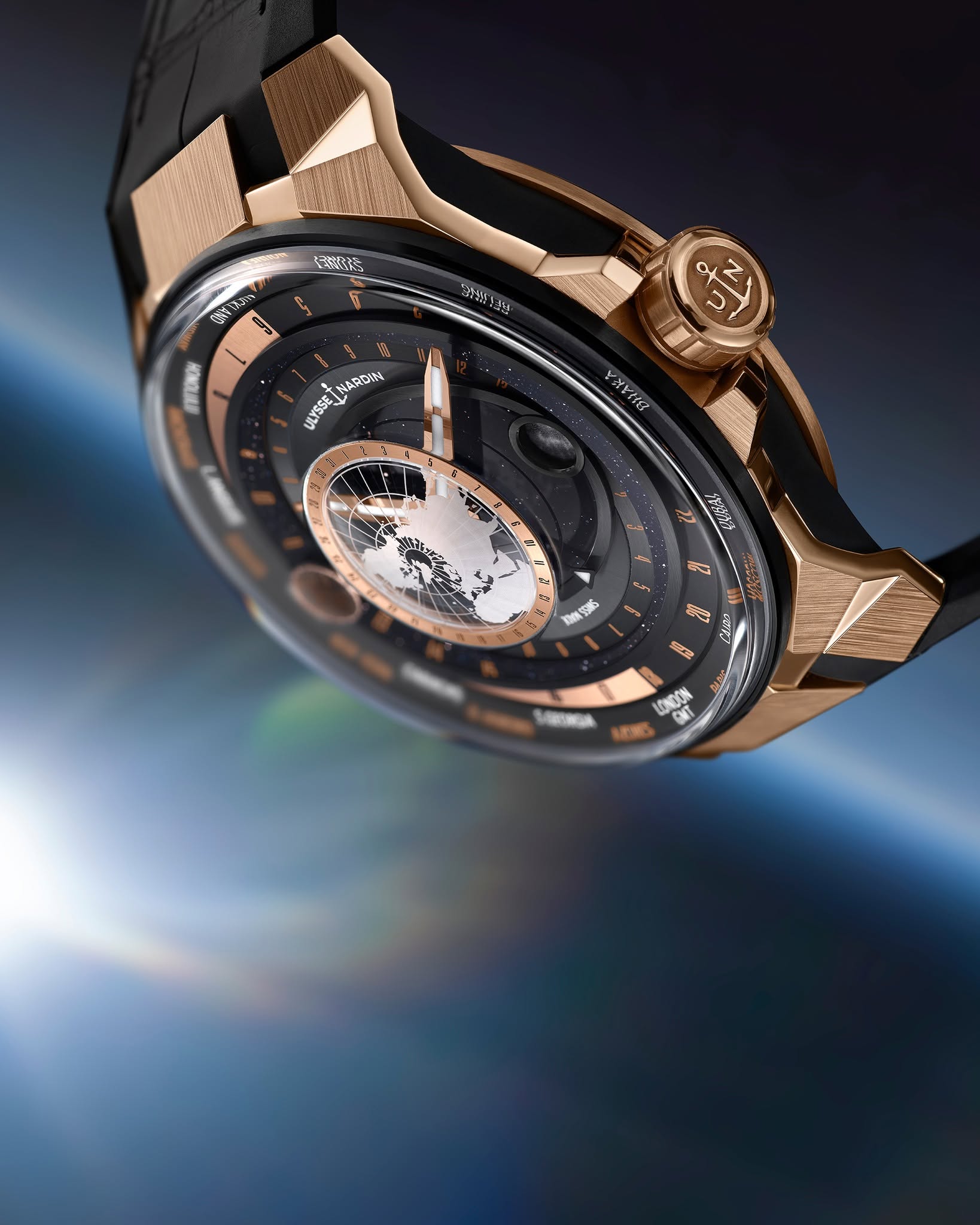
At the center of the dial is a three-dimensional model of the Northern Hemisphere, engraved on the underside of a domed sapphire structure and viewed as though from above the North Pole. Surrounding it, separate indications track the apparent positions of the sun and moon as they move around the globe over the course of a day and month.
According to Ulysse Nardin, the display draws on principles Oechslin applied throughout his career: presenting complex astronomical calculations through a format that can be read quickly, with the underlying mechanical complexity contained within the movement rather than the dial.
The sun’s position is shown on a rotating 24-hour disc marked with the world’s 24 principal time zones, allowing the wearer to read time in multiple zones at once. A two-tone day-and-night indication distinguishes daytime from nighttime across the globe. The moon indication tracks its own path around the dial, showing both the lunar phase and the progress of the lunar month. Ulysse Nardin said the moon phase display is accurate to within one day over a period of 40.3 years, at which point it would need to be reset.
The watch also includes a tidal coefficient indication, which uses the relative positions of the sun and moon to show periods of stronger and weaker tidal activity, a nod to the company’s history producing marine chronometers.
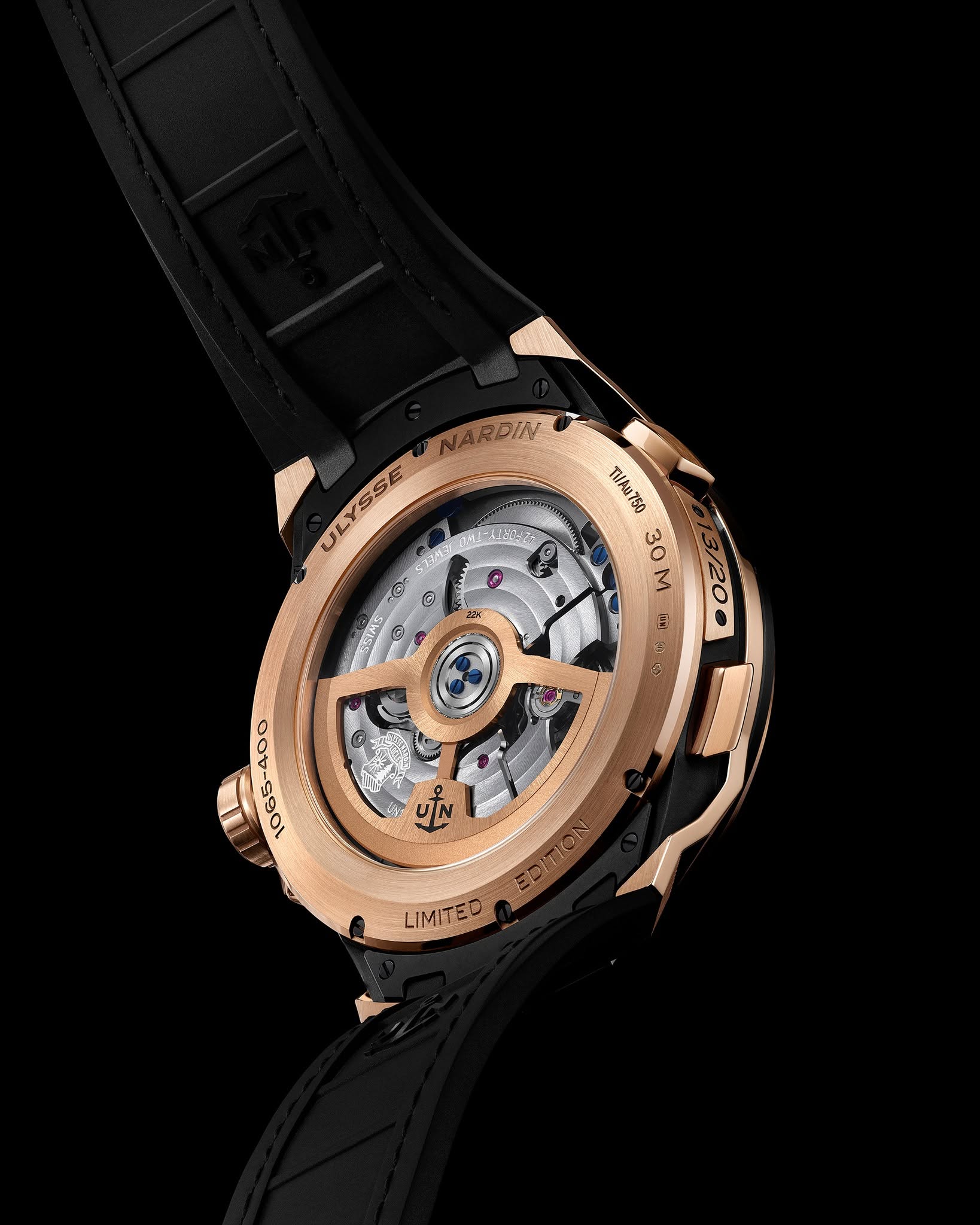
The watch is powered by the manufacture caliber UN-106, an automatic movement built by Ulysse Nardin that combines world-time and astronomical functions in a single mechanism. The movement is made up of 338 components and 42 jewels and includes a silicon escapement and silicon hairspring, materials the company began using in 2001 with its Freak model. Silicon components used in the watch are produced in-house by SIGATEC, Ulysse Nardin’s silicon manufacturing unit.
The caliber also includes a patented time-setting mechanism that allows the local time to be adjusted forward or backward in one-hour increments using pushers built into the side of the case, without affecting the watch’s astronomical indications. Separate settings for the astronomical functions can be adjusted through the crown. The movement runs at a frequency of 4 Hz, or 28,800 vibrations per hour, and has a power reserve of 50 hours.
The case measures 45 millimeters in diameter and combines an 18-karat rose gold upper case with a case middle and bezel made of black DLC-treated titanium. The upper case combines satin-finished and polished surfaces along with laser-finished facets. The case back is open, showing the movement through a sapphire crystal window, and includes a rose gold oscillating weight.
The dial is made of aventurine, a material with a naturally speckled surface intended to resemble a night sky, and sits beneath the suspended Northern Hemisphere model. A rose gold ring encircling the dial is engraved with the days of the month. The watch is fitted with a black alligator strap and a folding clasp made of black DLC-treated titanium and rose gold. It has a water resistance rating of 30 meters.
The timepiece, limited to 20 pieces, will retail in Malaysia for RM455,400
Images courtesy of The Hour Glass.


