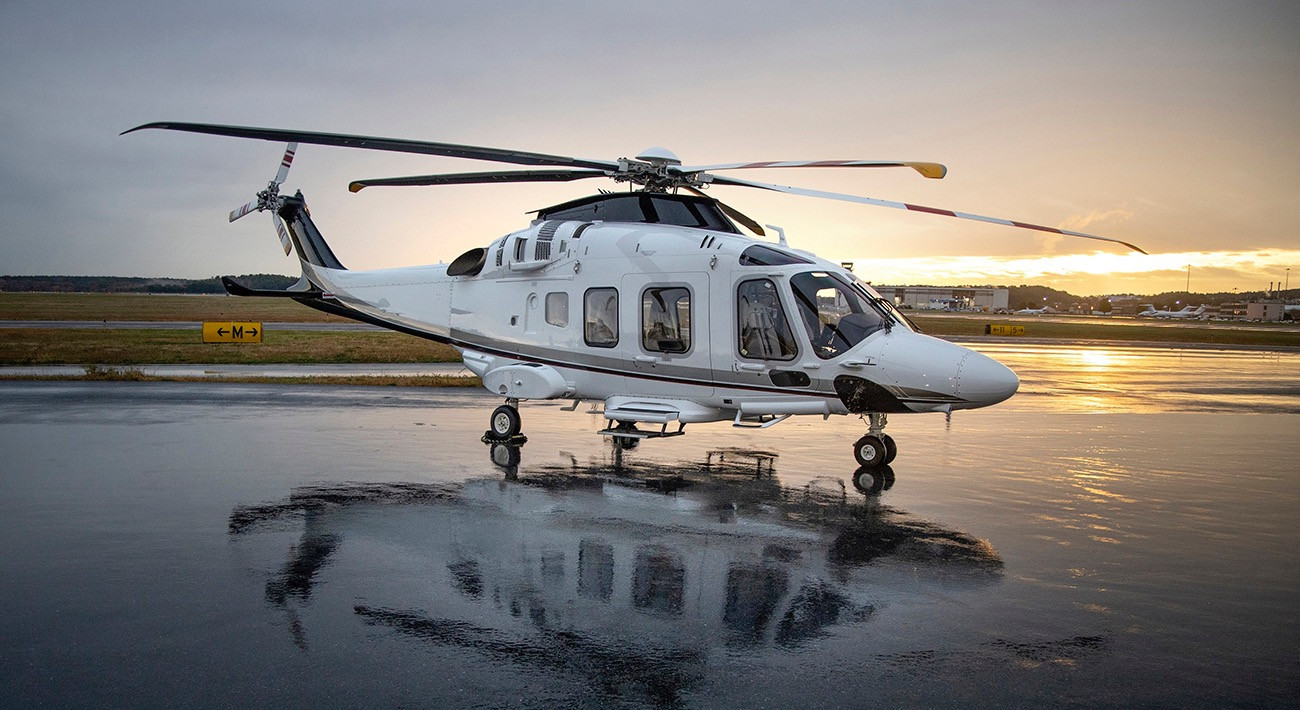
Aero Asahi Corporation, one of Japan’s largest general aviation service providers, will introduce an AW169 helicopter fitted out in a dedicated Agusta configuration, making it the first operator in Japan to fly an Agusta-branded VIP helicopter.
The AW169 is a light-intermediate, twin-engine helicopter. Aero Asahi’s aircraft will be finished under the Agusta brand, which Leonardo uses for its executive and VIP-configured helicopters, distinct from the standard AW169 sold for utility, medical and other commercial roles.
Aero Asahi became familiar with the aircraft after supporting a demonstration tour of the AW169 held in Japan in 2023. According to Leonardo, the helicopter is equipped with avionics and mission systems intended to support high-performance flight and navigation. The aircraft also has an auxiliary power unit that can run cabin and cockpit systems on the ground without the rotors turning, and it meets current-generation safety standards, the company said.
Aero Asahi’s aircraft is expected to be delivered in spring 2025. It will include soundproofing, VIP seating for up to eight passengers, a cabin management system with air conditioning controls, and an entertainment system. The contract also covers a maintenance and support package that Leonardo markets under the name Agusta For You.
Leonardo said the addition of the AW169 broadens its presence across a range of markets, including passenger transport. The company said it holds more than 900 helicopters in service across various models in the multi-engine VIP segment worldwide, and puts its share of that market at more than 40% by value over the past decade. The AW169 is positioned between Leonardo’s AW109 series and its larger AW139, both of which are also sold in VIP configurations.
Leonardo said more than 320 AW169s have been ordered to date, of which about 170 have been delivered from its final assembly line in Vergiate, Italy, to operators in more than 30 countries. The company said the worldwide AW169 fleet has logged more than 170,000 flight hours across a range of operating conditions.
Around 160 helicopters of various types, including AW169s, are currently in service in Japan, according to Leonardo, carrying out missions such as law enforcement, emergency medical service, search and rescue, firefighting, disaster relief, VIP and corporate transport, electronic news-gathering and maritime utility work.
The AW169 is a twin-engine helicopter in the roughly 5-tonne class, first unveiled at the Farnborough International Airshow in 2010 and flown for the first time in May 2012. It received European type certification from the European Union Aviation Safety Agency in July 2015, followed by U.S. Federal Aviation Administration certification in February 2016. More than 170 aircraft had been delivered as of late 2023. It was designed as a clean-sheet aircraft to sit between Leonardo’s smaller AW109 and larger AW139 models, sharing cockpit layout and handling characteristics with both to ease pilot transition between types. Depending on configuration, the aircraft can seat up to 11 people, including the cockpit, though Agusta’s VIP layouts typically accommodate between five and eight passengers.
Since entering service, the AW169 has been used mainly for emergency medical services, law enforcement, search and rescue and offshore energy work, with operators in more than 30 countries, according to Leonardo. Executive and VIP transport has been a smaller share of its overall fleet, with most early deliveries going to long-term public-service and medical contracts rather than corporate or private buyers. Leonardo has continued to update the design; in late 2023 it introduced a version with increased maximum takeoff weight, from 4,600 kilograms to 5,100 kilograms.
The deal gives Leonardo a foothold in Japan’s VIP and corporate helicopter segment, a market that has historically been served mainly by utility and public-service rotorcraft rather than dedicated executive aircraft. Japan’s roughly 160-strong helicopter fleet is weighted toward law enforcement, medical evacuation and disaster response, so the introduction of an Agusta-branded aircraft signals an attempt by Leonardo to diversify demand in the country beyond those traditional mission sets and into private and business aviation, an area that has been slower to develop in Japan than in North America, Europe or parts of the Middle East.
For Leonardo, the order also reinforces a broader strategy of using the Agusta brand to distinguish its executive-configured helicopters from the wider AW109, AW139 and AW169 product lines sold for utility and public-service work. Positioning the AW169 between the smaller AW109 and the larger AW139 gives the company a fuller range of VIP options by cabin size and mission profile, which may appeal to operators and private owners weighing trade-offs between passenger capacity, range and operating cost. With more than 320 AW169s on order and over 170,000 flight hours logged across the wider fleet, Leonardo can point to a reasonably established in-service record as it markets the type into new regions.
More broadly, the agreement is a modest but telling data point in the slow expansion of executive and VIP helicopter transport in Asian markets, where regulatory frameworks, heliport infrastructure and demand from corporate and high-net-worth customers have generally lagged more established markets. Whether Aero Asahi’s aircraft leads to further VIP orders in Japan will likely depend on how the type performs operationally and commercially once deliveries begin in 2025, as well as on wider trends in Japanese corporate and private aviation spending.
Photo by Agusta.


