UOB Malaysia equips more than 13,000 students with digital and AI skills through new flagship programme, UOB My Digital Space
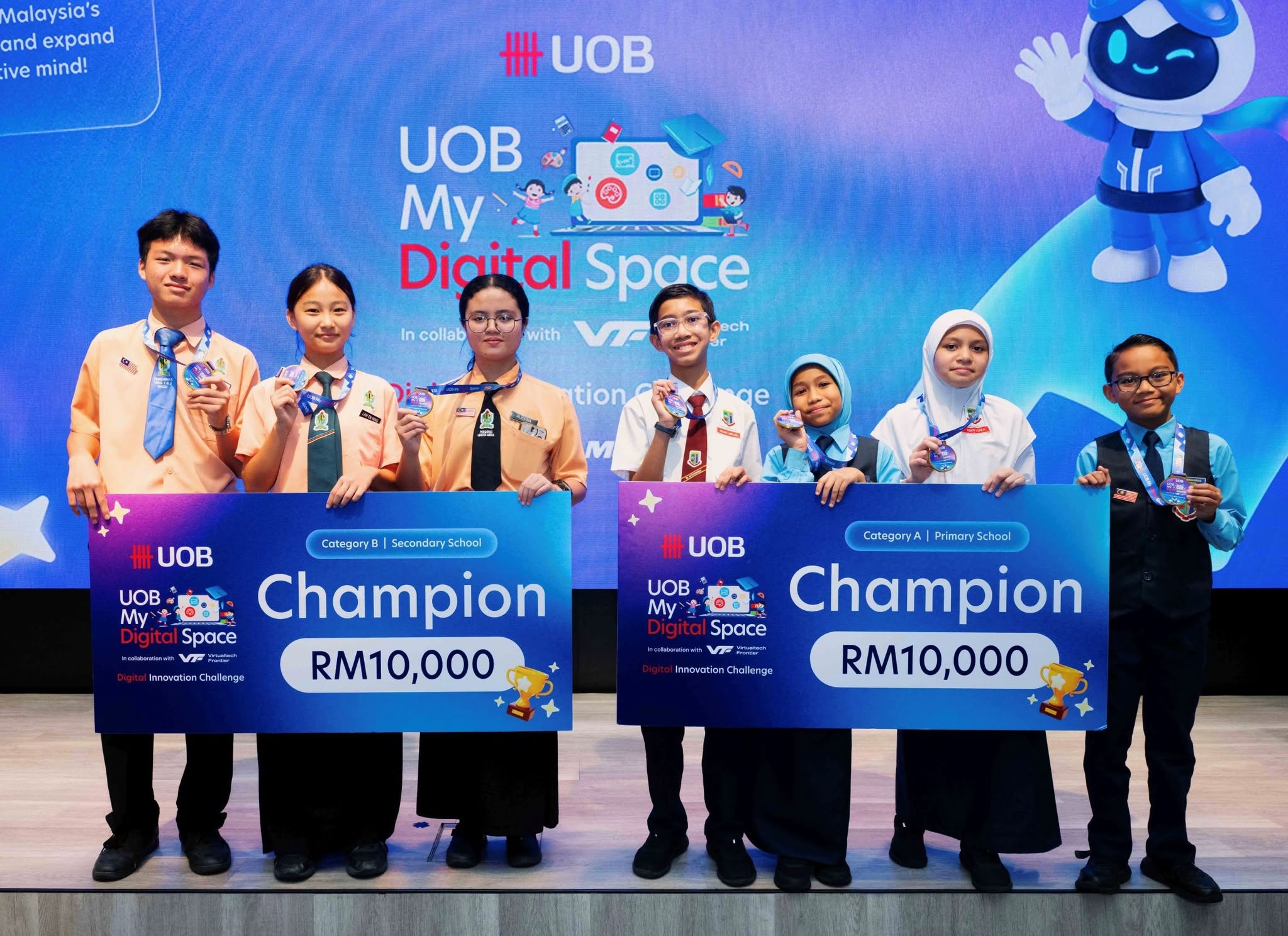
UOB Malaysia on 2 November 2026 held the grand finale of its UOB My Digital Space (MDS) Digital Innovation Challenge, marking the culmination of a digital education initiative the bank launched in Malaysia this year. The programme has reached more than 13,000 students nationwide through a combination of online learning and in-person workshops.
Through a series of interactive learning modules, students aged 10 to 16 developed skills in digital literacy, artificial intelligence (AI), creative thinking, design thinking and innovation. UOB Malaysia said the programme also encourages critical thinking, collaboration and adaptability, which it described as important skills in the future workforce.
“The future of Malaysia’s economy will be shaped by the next generation of innovators, creators and problem-solvers. Through UOB My Digital Space, we are equipping young people with the skills and confidence to thrive in an increasingly digital world. The ideas showcased through the challenge demonstrate what students can achieve when they are empowered to apply technology and AI to solve real-world problems. As a bank that has been here for 75 years in Malaysia, we remain committed to investing in future talent, supporting the country’s digital ambitions in line with the Malaysia Digital 2030 agenda, and helping build a more resilient and future-ready ASEAN.”
Datuk Ng Wei Wei, Chief Executive Officer, UOB Malaysia

Building on the programme’s learning modules, UOB Malaysia organised the Digital Innovation Challenge to give students a platform to develop and pitch digital solutions to real-world challenges. Under the theme “Digital ideas for a better future”, students were tasked with creating digital or AI-enabled solutions, and entries were evaluated on innovation, technology application, feasibility and potential impact.
The strongest submissions were shortlisted for the final, where teams took part in a live pitching and judging session.
In the primary school category, the team innov8 Crew from Sekolah Kebangsaan Setiawangsa, Kuala Lumpur, took the champion title with Sambung, an AI-enabled platform that promotes the sharing and reuse of school items to reduce waste and support learning accessibility. According to the project summary, the platform is school-managed: students offer items they no longer need, an AI check is applied, and other students can request and collect them.
In the secondary school category, Triple Trouble from Sekolah Menengah Kebangsaan Lutong, Sarawak, took top honours with Drive Alert, an AI-powered mobile application that helps detect driver fatigue and improve road safety. The project summary says the app uses a smartphone camera to monitor facial behaviour and classifies fatigue into three stages: normal, moderate and severe. It provides early warnings and emergency-contact support when fatigue is severe. Each champion team received RM10,000.
UOB Malaysia said the winning solutions were recognised for their innovation, practicality and potential to create a positive impact within the community.
The finalists’ projects covered a broad range of everyday problems. In the primary category, PJM from Sekolah Jenis Kebangsaan (C) Chung Hua Krokop, Sarawak, was first runner-up with a Smart Soil and Pest Monitoring System, which combines leaf image analysis with soil moisture monitoring to detect plant problems early. Wira Tech from Sekolah Kebangsaan Puncak Alam, Selangor, was second runner-up with Kembara, a platform that helps children discover and afford activities by earning points through free or low-cost ones.
In the secondary category, Stemfinity from Sekolah Menengah Kebangsaan Chung Hua (CF), Sarawak, was first runner-up with VoiceBridge AI, an assistive mobile application for people with speech and communication difficulties. ByteSize from Sekolah Menengah Jenis Kebangsaan Tiong Hua, Sabah, was second runner-up with SentinAI, a tool that analyses suspicious messages, links and recordings for signs of a scam.
Each category also named two consolation winners. Prizes across the two categories total RM60,000.
The programme is approved by the Ministry of Education and supported by the Malaysia Digital Economy Corporation (MDEC). It is delivered in partnership with Virtualtech Frontier.
UOB MDS is being implemented at various stages across the bank’s core markets in ASEAN and Greater China, including Singapore, Malaysia, Indonesia, Thailand, Vietnam and China. By 2025, the programme had reached more than 50,000 beneficiaries across Southeast Asia, which UOB said underscores its commitment to Building the Future of ASEAN by investing in the next generation of digitally ready talent.
Full list of winners
Primary schools
| Award | Team and school | Project | Prize |
|---|---|---|---|
| Champion | innov8 Crew, Sekolah Kebangsaan Setiawangsa, Kuala Lumpur | Sambung | RM10,000 |
| First runner-up | PJM, Sekolah Jenis Kebangsaan (C) Chung Hua Krokop, Sarawak | Smart Soil and Pest Monitoring System | RM8,000 |
| Second runner-up | Wira Tech, Sekolah Kebangsaan Puncak Alam, Selangor | Kembara | RM6,000 |
| Consolation | SaKSeS TECHNOVATE, Sekolah Kebangsaan Serdang, Selangor | SakSeS Smart School Report | RM3,000 |
| Consolation | KAPS2 ALPHA, Sekolah Kebangsaan (2) Kuala Ampang, Selangor | Ghost Tap | RM3,000 |
Secondary schools
| Award | Team and school | Project | Prize |
|---|---|---|---|
| Champion | Triple Trouble, Sekolah Menengah Kebangsaan Lutong, Sarawak | Drive Alert | RM10,000 |
| First runner-up | Stemfinity, Sekolah Menengah Kebangsaan Chung Hua (CF), Sarawak | VoiceBridge AI | RM8,000 |
| Second runner-up | ByteSize, Sekolah Menengah Jenis Kebangsaan Tiong Hua, Sabah | SentinAI | RM6,000 |
| Consolation | Finovators, Sekolah Menengah Kebangsaan Taman Pelangi Indah, Johor | FutureMe | RM3,000 |
| Consolation | X Kuasa Empat, Sekolah Menengah Kebangsaan Bandar Tasik Puteri, Selangor | AI Powered Student Discipline & Well-Being Ecosystem | RM3,000 |
Community education programmes are a familiar part of the work financial institutions do in the markets where they operate. UOB My Digital Space follows that tradition, but puts its emphasis on digital and AI skills for younger students rather than on financial literacy alone.
The programme has also changed shape over time. UOB introduced UOB My Digital Space in 2020 as part of its COVID-19 relief efforts, and in Malaysia it first took the form of laptops donated to children’s homes and schools so that children could continue learning remotely. This year’s version in Malaysia is a skills-based curriculum for students aged 10 to 16, with a competition at the end that gives participants a practical reason to apply what they have learnt.
That applied element is visible in the entries. Many teams began with everyday problems at school or at home, from reusing school items and caring for plants to driver tiredness and communication difficulties, and built working digital approaches to them. Two projects touched on themes that sit close to the financial sector: FutureMe, a planning app that lets students explore career pathways, estimate future tuition costs and set savings goals, and SentinAI, which assesses suspicious messages for scam risk. Both emerged from a challenge theme broad enough to let students choose their own starting point.
The programme is also part of a wider regional effort. UOB has said UOB My Digital Space is expected to benefit more than 100,000 students across the region, and the Malaysian cohort of more than 13,000 forms part of that picture. Ng tied the Malaysian programme to the country’s national digital ambitions, and the involvement of the Ministry of Education and MDEC places it within the school system and the wider digital economy agenda rather than alongside it.
For the students who took part, the finale offered a chance to present their ideas to a panel of judges and see them recognised. As more of daily life and work moves online, programmes of this kind give young Malaysians early, practical exposure to the tools shaping that shift, a modest but useful contribution to the country’s pipeline of digital talent.
Photos by the respective brands.
Cover photo by UOB.


